Showing posts with label Hebrew. Show all posts

Saturday, 4 April 2015

Does Job say the sky is solid?

Job 37:18 says
Can you, like him, spread out the skies,/
hard as a cast metal mirror? (ESV)

will you, with him, spread out the clouds,/
solid as a mirror of molten metal? (NET)

can you join him in spreading out the skies,/
hard as a mirror of cast bronze? (NIV)

Can you, with him, spread out [raqa`] the skies [shachaq],/
strong [chazaq] as a mirror [r'iy] of molten [yatsaq] metal?
raqa` means to "spread out".

shachaq is more often translated "clouds" or "dust". It is less often used for "heaven" and the more common word for heaven is the Bible is shamayim.

chazaq means "strong", so "hard" or "solid" seems reasonable if the context is that of a solid object.

r'iy means means "appearance". The more common word for mirror is mar'ah. Mirror may seem an appropriate translation based on the meaning "appearance".  However the Septuagint doesn’t translate the word as “mirror” but “appearance”.

yatsaq means to "pour out". It is translated into English as "molten" only here. As mirrors were made of metal (not glass) poured out metal is molten metal. Thus a reasonable translation if mirror is correct. But what is a molten mirror? One in the process of being cast (see ESV and NIV)? But a molten mirror would not be hard or strong, though perhaps mighty or powerful. The word "metal" is supplied for clarification, it is not in the Hebrew.

Going with the more usual meanings of the words (if the context allows it), for the first half of the verse we get, as per the NET,
Will you, with him, spread out the [strong] clouds,/
Newman translates the verse
Can you, with Him, spread out the mighty clouds,
With an appearance of being poured out?

Wednesday, 24 November 2010

Computer software deciphers Ugaritic

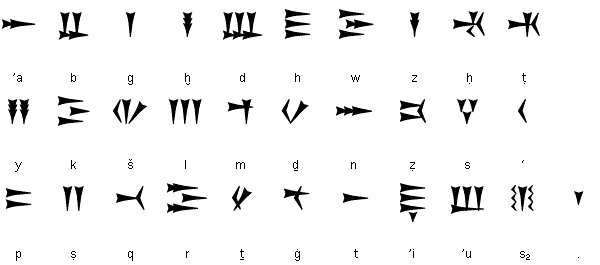
Programmers have used statistical techniques to correlate Ugaritic and Hebrew alphabets as well as forms of words which they assume are somewhat parallel in related languages in order to decipher Ugaritic.
To duplicate the “intuition” that Robinson believed would elude computers, the researchers’ software makes several assumptions. The first is that the language being deciphered is closely related to some other language: In the case of Ugaritic, the researchers chose Hebrew. The next is that there’s a systematic way to map the alphabet of one language on to the alphabet of the other, and that correlated symbols will occur with similar frequencies in the two languages.

The system makes a similar assumption at the level of the word: The languages should have at least some cognates, or words with shared roots, like main and mano in French and Spanish, or homme and hombre. And finally, the system assumes a similar mapping for parts of words. A word like “overloading,” for instance, has both a prefix — “over” — and a suffix — “ing.” The system would anticipate that other words in the language will feature the prefix “over” or the suffix “ing” or both, and that a cognate of “overloading” in another language — say, “surchargeant” in French — would have a similar three-part structure.

The system plays these different levels of correspondence off of each other. It might begin, for instance, with a few competing hypotheses for alphabetical mappings, based entirely on symbol frequency — mapping symbols that occur frequently in one language onto those that occur frequently in the other. Using a type of probabilistic modeling common in artificial-intelligence research, it would then determine which of those mappings seems to have identified a set of consistent suffixes and prefixes. On that basis, it could look for correspondences at the level of the word, and those, in turn, could help it refine its alphabetical mapping. “We iterate through the data hundreds of times, thousands of times,” says Snyder, “and each time, our guesses have higher probability, because we’re actually coming closer to a solution where we get more consistency.” Finally, the system arrives at a point where altering its mappings no longer improves consistency.
Ugaritic was treated as unknown and the resultant translation turned out to be reasonably accurate.

This is beneficial for languages that are related, that is both are derived from a common source. It does not seem to be of use if we discovered a language unrelated to any known ones (unlikely). But it could help with increasing deciphering speed in poorly characterised languages.
“Each language has its own challenges,” Barzilay agrees. “Most likely, a successful decipherment would require one to adjust the method for the peculiarities of a language.” But, she points out, the decipherment of Ugaritic took years and relied on some happy coincidences — such as the discovery of an axe that had the word “axe” written on it in Ugaritic. “The output of our system would have made the process orders of magnitude shorter,” she says.

Indeed, Snyder and Barzilay don’t suppose that a system like the one they designed with Knight would ever replace human decipherers. “But it is a powerful tool that can aid the human decipherment process,” Barzilay says. Moreover, a variation of it could also help expand the versatility of translation software. 

Friday, 5 February 2010

The number of the beast

This calls for wisdom: let the one who has understanding calculate the number of the beast, for it is the number of a man, and his number is 666. (Revelation 13)

I think it is likely that this number refers at least to Nero. If this is the case it has implications for the dating of the book of Revelation which I think was written prior to 70 AD.

In this passage we note the the number of the beast is the number of a man. This does not necessarily mean that the beast is a man, just that the number of the beast is the number of a man.

The number of a man may be the number of the name via gematria. Nero Caesar's number in Greek is 1337, but his number in Hebrew is 666. The call for wisdom may have meant that the number needed to be calculated in Hebrew, not Greek. The association with Nero is very ancient, almost certainly as old as the book of Revelation. Nero Caesar does not have a gematria in Latin (that I am aware of), the Latin numbering scheme does not lend itself to this. But transliteration of Nero Caesar from Latin to Hebrew gives the number 616 which is mentioned in several manuscripts of Revelation. This confirms that the authors of the variant manuscripts thought Nero was intended. Below are the calculations.

Greek Number Hebrew NumberLatin Hebrew Number
Ν 50 נ 50 N נ50
Ε 5 --E--
Ρ 100ר200Rר200
Ω 800 ו 6 O ו 6
Ν 50 נ50---
- - - - - - -
Κ 20 ק 100 C ק100
Α 1 - - A - -
Ι 10 - - E --
Σ 200 ס 60 S ס 60
Α 1 - - E - -
Ρ 100 ר 200 R ר 200
Total 1337 666 616

Though Nero's gematria in Greek is given by Suetonius without the Caesar resulting in 1005.

Thursday, 4 February 2010

Hebrew and Greek numbering

In ancient Hebrew the letter glyphs doubled as numeral glyphs, the same symbol could be a letter or a number depending on the context. Written Hebrew did this several centuries before Christ. In Hebrew the glyphs for the numbers 400–900 are final forms (the alternate shape of letters when they are the last letter of a word) and I am uncertain how old they are, or if paleo-Hebrew had glyphs for higher numbers. The higher hundreds can be written as a combination of the lower hundreds glyphs.

Greek used a similar system called the Milesian (or Ionian) system which replaced the earlier Attic system. The Attic system was somewhat similar to the Roman system. Greek uses 3 glyphs that had become obsolete at the time it was used to allow numbering to 900; though the position of fau (Ϝ) leaves one curious as to whether it may still have been in use at the time the system was invented/ copied.

Below are the Hebrew and Greek glyphs for the corresponding numbers. The lower case Greek was non-existent at the time of the New Testament.

Hebrew Glyph Number Greek Glyph
א 1Α α
ב 2Β β
ג3Γ γ
ד4Δ δ
ה 5Ε ε
ו 6Ϝ ϝ
ז 7Ζ ζ
ח 8Η η
ט 9Θ θ
י 10Ι ι
כ, ך20Κ κ
ל 30Λ λ
מ, ם 40Μ μ
נ, ן 50Ν ν
ס 60Ξ ξ
ע 70Ο ο
פ, ף 80Π π
צ, ץ 90Ϙ ϙ
ק 100Ρ ρ
ר 200Σ σ
ש 300Τ τ
ת 400Υ υ
ך 500Φ φ
ם 600Χ χ
ן700Ψ ψ
ף 800Ω ω
ץ 900Ͳ ͳ

Thus 23 is written ΚΓ, and 799 is ΨϘΘ.

Gematria is the association of words with numbers. The development of a word to number correspondence is understandable because the twofold sense of the glyphs. Every word has an associated number that is obtained by adding up the values of the glyphs read as numbers. For example the word king melek (מלך) is calculated as 40 + 30 + 20 = 90 (assuming 20 rather than 500 for kaph). David (דוד) is 4 + 6 + 4 = 14. This may be why Matthew included groups of 14 in his genealogy of Jesus.

Labels

abortion (8) absurdity (1) abuse (1) accountability (2) accusation (1) adultery (1) advice (1) afterlife (6) aid (3) alcohol (1) alphabet (2) analogy (5) analysis (1) anatomy (1) angels (1) animals (10) apologetics (47) apostasy (4) apostles (1) archaeology (23) architecture (1) Ark (1) Assyriology (12) astronomy (5) atheism (14) audio (1) authority (4) authorship (12) aviation (1) Babel (1) baptism (1) beauty (1) behaviour (4) bias (6) Bible (41) biography (4) biology (5) bitterness (1) blasphemy (2) blogging (12) blood (3) books (2) brain (1) browser (1) bureaucracy (3) business (5) calendar (7) cannibalism (2) capitalism (3) carnivory (2) cartography (1) censorship (1) census (2) character (2) charities (1) children (14) Christmas (4) Christology (8) chronology (54) church (4) civility (2) clarity (5) Classics (2) classification (1) climate change (39) coercion (1) community (3) conscience (1) contentment (1) context (2) conversion (3) copyright (5) covenant (1) coveting (1) creation (5) creationism (39) criminals (8) critique (2) crucifixion (14) Crusades (1) culture (4) currency (1) death (5) debate (2) deception (2) definition (16) deluge (9) demons (3) depravity (6) design (9) determinism (27) discernment (4) disciple (1) discipline (2) discrepancies (3) divinity (1) divorce (1) doctrine (4) duty (3) Easter (11) ecology (3) economics (28) education (10) efficiency (2) Egyptology (10) elect (2) emotion (2) enemy (1) energy (6) environment (4) epistles (2) eschatology (6) ethics (36) ethnicity (5) Eucharist (1) eulogy (1) evangelism (2) evil (9) evolution (13) examination (1) exegesis (22) Exodus (1) faith (22) faithfulness (1) fame (1) family (5) fatherhood (2) feminism (1) food (3) foreknowledge (4) forgiveness (4) formatting (2) fraud (1) freewill (29) fruitfulness (1) gematria (4) gender (5) genealogy (11) genetics (6) geography (3) geology (2) globalism (2) glory (6) goodness (3) gospel (4) government (18) grace (9) gratitude (2) Greek (4) happiness (2) healing (1) health (7) heaven (1) Hebrew (4) hell (2) hermeneutics (4) history (24) hoax (5) holiday (5) holiness (5) Holy Spirit (3) honour (1) housing (1) humour (36) hypocrisy (1) ice-age (2) idolatry (4) ignorance (1) image (1) inbox (2) inerrancy (17) infinity (1) information (11) infrastructure (2) insight (2) inspiration (1) integrity (1) intelligence (4) interests (1) internet (3) interpretation (87) interview (1) Islam (4) judgment (20) justice (25) karma (1) kingdom of God (12) kings (1) knowledge (15) language (3) lapsology (7) law (21) leadership (2) libertarianism (12) life (3) linguistics (13) literacy (2) literature (21) logic (33) love (3) lyrics (9) manuscripts (12) marriage (21) martyrdom (2) mathematics (10) matter (4) measurement (1) media (3) medicine (11) memes (1) mercy (4) Messiah (6) miracles (4) mission (1) monotheism (2) moon (1) murder (5) names (1) nativity (7) natural disaster (1) naval (1) numeracy (1) oceanography (1) offence (1) orthodoxy (3) orthopraxy (4) outline (1) paganism (2) palaeontology (4) paleography (1) parable (1) parenting (2) Passover (2) patience (1) peer review (1) peeves (1) perfectionism (2) persecution (2) perseverance (1) pharaohs (5) philanthropy (1) philosophy (34) photography (2) physics (18) physiology (1) plants (3) poetry (2) poison (1) policing (1) politics (31) poverty (9) prayer (2) pride (2) priest (3) priesthood (2) prison (2) privacy (1) productivity (2) progress (1) property (1) prophecy (7) proverb (1) providence (1) quiz (8) quotes (637) rebellion (1) redemption (1) reformation (1) religion (2) repentance (1) requests (1) research (1) resentment (1) resurrection (5) revelation (1) review (4) revival (1) revolution (1) rewards (2) rhetoric (4) sacrifice (4) salt (1) salvation (30) science (44) self-interest (1) selfishness (1) sermon (1) sexuality (20) shame (1) sin (16) sincerity (1) slander (1) slavery (5) socialism (4) sodomy (1) software (4) solar (1) song (2) sovereignty (15) space (1) sport (1) standards (6) statistics (13) stewardship (5) sublime (1) submission (5) subsistence (1) suffering (5) sun (1) survey (1) symbolism (1) tax (3) technology (12) temple (1) testimony (5) theft (2) toledoth (2) trade (3) traffic (1) tragedy (1) translation (19) transport (1) Trinity (2) truth (27) typing (1) typography (1) vegetarianism (2) vice (2) video (10) virtue (1) warfare (7) water (2) wealth (9) weird (6) willpower (4) wisdom (4) witness (1) work (10) worldview (4)