Showing posts with label linguistics. Show all posts

Sunday, 28 April 2013

The semantic range of "to be"

Don Carson discusses several meanings for the linking verb "to be". He lists
  1. Identity
  2. Attribute
  3. Cause
  4. Resemblance
  5. Fulfilment
Examples of these 5
  1. A cat is an animal
  2. The coat is leather
  3. Listening is wisdom
  4. People are sheep
  5. That is what I said would happen
We can expand these sentences to restrict the semantic range of "is" and remove potential ambiguity by modifying the verb.
  1. The cat belongs to the group animal
  2. The coat is made of leather
  3. Listening makes a person wise
  4. People behave like sheep
  5. This event corresponds to what I said would happen
Note that Identity is not always Equivalence. Equivalence is a special case of Identity where the subject and object can be interchanged such as "Clark Kent is Superman" or "aubergines are eggplants".

A 6th category (or perhaps a special case of "Attribute") is "Temporal/ Spatial," "the coat is on the floor."

Identity and Attribute can be essential (always belonging to the subject) or incidental (happening to belong to the subject).

Carson discusses this using the Greek verb (eimi) which appears to have a similar semantic range to English. His examples from the Bible are
  1. Is the law sin? (Rom 7:7)
  2. No one is good except God alone. (Mar 10:18)
  3. To be carnally minded is death (Rom 8:6)
  4. The tongue is a fire. (Jam 3:6)
  5. This is what was spoken by the prophet (Act 2:16)
The context usually makes the meaning of "to be" clear, but discussion is needed about what is meant when there is ambiguity. Disputable or ambiguous passages include "this is my body" and "the Word was God".

Saturday, 2 March 2013

The Word was God

In the beginning was the Word, and the Word was with God, and the Word was God. (John 1:1)
Concerning the last clause of this verse some claim that the Greek implies that the Word is a god. This is not a valid claim. This has to do with grammatical construction in Greek. This is my understanding as a non-Greek reader.

In English we can have the sentence,
1. The dog chased the cat.
This is different from,
2. The cat chased the dog.
In sentence 1 the "dog" is the subject and the "cat" is the object. In sentence 2 it is the opposite. In English we get this from the word order. If we change the word order we have to rewrite the sentence, usually in the passive, to get the same meaning,
The cat was chased by the dog.
In several other languages including Greek the subject and object can be identified by the ending on the noun. So you could put either the subject or the object first (or even the verb!) depending on what you wish to emphasise. That is, word order doesn't give meaning in Greek the same way it does in English (in general).

The problem is the verb "to be" is an identifier, an equating verb. So both words are the subject. There is no object. Take,
The man is the father.
Both man and father are the subject as the "man" is identified with the "father". However the sentence,
The father is the man
while still equating the man and the father does not mean the same thing. In English this is not a problem as the word order gives us the meaning. There is a problem in Greek though because both the words are the subject, this means that the nouns have the same ending, this means we cannot tell which word is being identified with which. Take the Greek phrase (using English words)
God love be.
What would this mean? Does it mean?
"God is love"
or?
"Love is God"
Very different meanings! Therefore the Greek phrase
ο θεος ην ο λογος

the God to-be the Word
could actually mean (in English)
"The Word was God"
or
"God was the Word."
In Greek the definite article "the" is not included with the word which is being equated (predicate noun) if that word precedes the verb and the definite article is included when it follows the verb. So if we are equating "God" with the "Word" and the word "God" comes before the word "to be" we drop the definite article "the."

Thus, if the intention of the sentence is
The Word was God
then it would be written
θεος ην ο λογος (God to-be the Word)
Which is what we see. The lack of the article says nothing about Jesus being "a" god rather than "the" God. Incidentally, Greek has no indefinite article, we add it in English. Further the definite article is frequently used in Greek (eg. in front of personal names) but it is left off in English because that is not how English is spoken.

This is not the full story however. While the idea "the Word was God" is written in Greek as recorded in John 1, what is written there could also have other meanings. Thus if "a god" was intended it would possibly be written the same way. While the claim—that the construction of the clause proves that "a god" is intended—is a false claim; the counter claim—that it must mean "God"—is not sustainable. A refutation of a negative claim may not actually be a positive claim.

Others have claimed a further interpretation of this construction. The NET Bible notes state,
Furthermore, Colwell’s Rule did not deal with a third possibility, that the anarthrous [without the definite article] predicate noun may have more of a qualitative nuance when placed ahead of the verb. A definite meaning for the term is reflected in the traditional rendering “the word was God.” From a technical standpoint, though, it is preferable to see a qualitative aspect to anarthrous θεός in John 1:1c.
Thus the word order has implications in Greek (though different implications than English). The claim is that placing "God" before "to be" is qualifying the following word "Word" with itself; both words have a dual identity. Thus the meaning of the phrase would be,
What God was the Word was.
This has a slightly different meaning than, "The Word was God," though the implications are similar.

Wednesday, 4 April 2012

What language did Jesus speak?

In his article "What Language Did Jesus Speak? Why Does It Matter?" Mark D. Roberts argues that the main language spoken by Jews in the first century was Aramaic which he suggests is also Jesus' primary language. He also argues that Jesus was at least bilingual also speaking Hebrew, and probably trilingual also speaking Greek.

Most of what he writes seems reasonable, though I have some sympathy for the idea that the Jews spoke Hebrew. One place I may differ with Roberts is what we the Dead Sea Scrolls imply. He states Hebrew is more common in these Scrolls.
During and before the time of Jesus, there wasn’t just one version of Aramaic being used in Judea and beyond. Some Aramaic was official and formal. This is preserved, as you would expect, in official documents and inscriptions. Some was informal and common. This was spoken and has mostly been lost to modern scholars. The fact that Aramaic was used by Jews in Judea is supported by its use in some of the Dead Sea Scrolls (which are mostly in Hebrew, however), and in some ancient documents and inscriptions. Even many grave inscriptions around Jerusalem are in Aramaic, not Hebrew. It’s most likely that in Galilee, where Jesus was raised and where he began his ministry, Aramaic was the most common language of the people, though many would have been able to understand Hebrew and to get along in Greek as well.
And he is prepared to concede that the Qumran community may have spoken Hebrew in preference to Aramaic
By the time of Jesus, Aramaic was the most common language in Judea, though Hebrew may have been dominant in certain areas, such as Jerusalem or the Qumran community by the Dead Sea. Greek usage was also widespread in those regions during the first century A.D.
The Dead Sea Scrolls were hidden in Qumran, but if many of them originated from elsewhere in Judea such as Jerusalem then perhaps Hebrew was more widespread than Roberts concludes?

Friday, 29 July 2011

The meaning of "expanse" in Genesis 1. Part 6

Part 1. Part 2. Part 3. Part 4. Part 5.

BioLogos have an article on the firmament of Genesis 1, "The Firmament of Genesis 1 is Solid but That’s Not the Point", by Peter Enns. He begins by twice asserting that biblical scholars agree that the expanse (raqiya`) is solid and appeals to observation of the horizon and the assumption ancients thought the world flat.
Ancient Israelites “saw” this barrier when they looked up. There were no telescopes, space exploration, or means of testing the atmosphere. They relied on what their senses told them. Even today, looking up at a clear sky in open country, the sky seems to “begin” at the horizons and reaches up far above. Ancient Israelites and others in that part of the world assumed the world was flat, and so it looked like the earth is covered by a dome, and the “blue sky” is the “water above” held back by the raqia
Really? Clouds clearly move across the sky, as does the sun and moon, and even stars. Does the sky really look solid, or is solidity invoked by some cultures to explain rain? Enns does not mention that a curved horizon could lead observers to think the earth spherical, especially combined with observing lunar eclipses.

He goes on to discuss word meanings.
The translation “firmament” (i.e., firm) gets across this idea of a solid structure.
The comment on "firmament" is unhelpful because, although it does carry the idea of firmness, he implies by using the word "translation" in the above sentence that raqiya` means firm when the etymology of "firmament "is actually via Latin.
Biblical scholars agree on this understanding of raqia. For some Christians, however, this is troubling. How can the Bible, which is the inspired, revealed word of God, contain such an inaccurate piece of ancient nonsense? Hence, some invest a lot of time and energy to show that the raqia is not solid but more like the atmosphere. Often, the word “expanse” is the preferred translation because it does not necessarily imply something solid.
We will note here that Young's Literal Translation published in 1898 uses the word "expanse". And "expanse" is considered more accurate given that raqiya` is more likely related to "spread out" than it is to "solidity".
The second problem is a much larger theological issue, but is actually more foundational. Regardless of what one thinks of the raqia, why would anyone assume that the ancient cosmology in Genesis could be expected to be in harmony with modern science in the first place?
Well it may not be in harmony with modern science, by why can it not be in harmony with the truth? If the atmosphere is how it is, why can Scripture and science not both be in harmony with this? Is it somehow better to have Scripture not concordant with the way things are? Modern science understands pregnancy in greater detail than understood by the ancients. Following Enns here it would seem that an inaccurate understanding of the virgin birth by the ancients be more likely to be recorded than an accurate one. But the ancients knew that virgin conceptions were impossible, even if they did not understand activation. Why cannot the ancients appreciate a non-solid expanse even if they did not understand partial pressures of gases, absolute temperatures, and triple points? Every observable can be considered a fact of science. Should every observation in Scripture be expected to be at odds with reality because it can also be described by modern science?

As a matter of clarification, I don't think that Genesis is in harmony with several scientific cosmologies.
Genesis and modern science are neither enemies nor friends, but two different ways of describing the world according to the means available to the people living at these different times. To insist that the description of the sky in Genesis 1 must conform to contemporary scientific is a big theological problem. It is important to remember that God always speaks in ways that people can actually understand. In the ancient world, people held certain views about the world around them.
There is some truth to this latter comment, God may talk in ways that men understand (though not always). An important distinction here is that simplification is not the same as falsity. As Sarfati has often said
A mother might tell her four-year-old ‘you grew inside my tummy’—this is not false, but language simplified to the child’s level (‘tummy’ as a broad term for the abdominal region, but not as specific as ‘uterus’). Conversely, ‘the stork brought you’ is an outright error.
The greater problem here, however, is separating knowledge into scientific and biblical. Yes they are distinct, but by nature of the way they arrive at knowledge. They are epistemologically distinct. But that does not mean they speak to different topics. They may make competing claims on the nature of reality and real events of history. To have an account in the Bible that corresponds generally to the way things actually are, even if that coincides with contemporary science, is hardly a theological problem.

Enns then lays out 7 reasons for solidity of the expanse:
  1. The other cosmologies from the ancient world depict some solid structure in the sky. The most natural explanation of the raqia is that it also reflects this understanding. There is no indication that Genesis is a novel description of the sky;
  2. Virtually every description of raqia from antiquity to the Renaissance depicts it as solid. The non-solid interpretation of raqia is a novelty;
  3. According to the flood story in Gen 7:11 and 8:2, the waters above were held back only to be released through the “floodgates of the heavens” (literally, “lattice windows”);
  4. Other Old Testament passages are consistent with the raqia being solid (Ezekiel 1:22; Job 37:18; Psalm 148:4);
  5. According to Gen 1:20, the birds fly in front of the raqia (in the air), not in the raqia;
  6. The noun raqia is derived form the verb that means to beat out or stamp out, as in hammering metal into thin plates (Exodus 39:3). This suggests that the noun form is likewise related to something solid;
  7. Speaking of the sky as being stretched out like a canopy/tent (Isaiah 40:22) or that it will roll up like a scroll (34:4) are clearly similes and do not support the view that raqia in Genesis 1 is non-solid.
Many of these I have addressed previously but briefly
  1. Item #1 may be true, but then perhaps the Israelites didn't borrow as much as we think, especially when we consider that Genesis 1 is much older than other cosmologies often referenced.
  2. I have not identified every occurrence nor researched their content so cannot answer item #2.
  3. Genesis 7:11 and 8:2 reference the "windows of heaven" and the "fountains of the great deep". These are likely idioms. Nor does either passage actually suggest that the "windows of heaven" let thru the "waters above".
  4. I have addressed Ezekiel 1 and Psalm 148 here. Job 37 (as currently translated) is suggestive of Enns' thesis, and requires a discussion of its own
  5. In item #5 he mentions that birds fly on the face or surface of the expanse to which I concur. But this means that the surface at least is non-solid, and other passages mention birds within the expanse/ heavens. Using Enns' own reasoning here the expanse must be non-solid.
  6. Item #6 is a difficult issue. I have addressed it here. The problem is that while etymology is helpful, it is not definitive. And it is likely that the idea transferred to the noun is "spread out", not the metal which happens to be beaten.
  7. Item #7 is errant. These are clearly similes as I discuss here, but the association between the tent and heavens is that they are stretched out, not the material they are made from. The sky is stretched out like the way that a tent is stretched out. Consider the phrase, "The boy ran like lightening." This is a simile, but no one would interpret the simile implies the boy is made of electricity.
I don't have much to address in the latter part of the essay. I do not give a lot of credence to the phenomenological argument he tries to refute, other than saying that idioms do not necessarily mean what they literally say. But Genesis 1 is not using an idiom here. The moon comment is irrelevant. Objects can be lights directly or indirectly. The moon is a light whether it intrinsically produces electromagnetic radiation, or just reflects it.

We get to the end of the article. Enns finishes by saying
It is important to be clear on what we have a right to expect from Genesis. This is central to making progress in the conversation between science and faith.
And while I agree with this statement, Enns fails to mention what we can expect from Genesis. I suspect what he and I think is reasonable to exegete from Genesis differs considerably. A repeating theme is that ancient Israelites did not have modern knowledge (or equipment to gain them scientific knowledge). This assumes that what they wrote was based on their (false) beliefs about cosmology, which is usually assumed to be borrowed from other contemporary cultures. It is important to note here that Christians understand Scripture to be supernaturally revealed. Of course the Bible is historical. It touches events in history that were witnessed by Hebrews within and Gentiles without. We have documentary and archaeological evidence on biblical happenings. However while authors used historical sources and observation, insights into the meaning of events was often given by God. And even some historical events require supernatural revelation; how else would we be privy to dialogue between Yahweh and Satan concerning Job?

It would seem that Genesis 1 as history would need to be exclusively revealed as no humans witnessed it. If God created the universe, and if he could reveal the events of the 6 days of creation, and if Genesis 1 can easily be interpreted in line with what we actually observe about the earth and the atmosphere, then why the the desire to force errancy?

Friday, 29 April 2011

The meaning of "expanse" in Genesis 1. Part 5

Part 1. Part 2. Part 3. Part 4.

Seely's second and third essays cover slightly different topics than the expanse per se. The second essay is on the water above the expanse and the third on ancient views of the earth and seas.

In Seely's second essay "The Firmament and the Water Above Part II: The Meaning of 'The Water above the Firmament' in Gen 1:6-8" from The Westminster Theological Journal 54 (1992) (pdf) he discusses the waters above the expanse. Though I disagree with his conclusions he makes a few valid points. I am not going to discuss the waters above in this series so I will just say that I think much of my disagreement here relates to his emphasis on other cultures. Interestingly, Genesis is somewhat unique here anyway,
Among scientifically naive peoples, who have universally believed in a solid firmament, only a very few seem to have a concept of an ocean or of water being stored in bottles above the firmament. We must beware of arguing from silence, but the vast majority of primitive peoples evidence no belief in a body of water existing above the firmament.
As I previously said, I think Genesis is primary so there is much less to learn from other cosmogonies concerning the interpretation of Genesis than Seely thinks there is.
There are also, of course, obvious differences between the two accounts both materially and even more so in their contrasting theologies. Furthermore, there is no reason to believe that Genesis is dependent upon Enuma Elish. Nevertheless, the two accounts are both ancient Near Eastern documents containing some very similar concepts and there may well be some genetic connection between them. Consequently, Enuma Elish is an important historical document for shedding light on the concepts employed in Genesis 1. This is particularly true with regard to nontheological matters wherever a parallel clearly exists between the two accounts.
If they are both dependant on a common source perhaps; but even if this were the case, if Genesis is essentially edited narrative and Enuma Elish is mythologised history and speculation then the latter is less helpful in interpreting Genesis than vice versa.

Seely's third essay is "The Geographical meaning of 'Earth' and 'Seas' in Genesis 1:10" Westminster Theological Journal 59 (1997). Again he discusses views from other ancient cultures. He describes an ancient view of the earth as flat with an inverted bowl forming the sky. I find this comment interesting,
Scientifically naive peoples everywhere regularly conceive of the earth as a single continent in the shape of a flat circular disc. There are rare exceptions; but, in no case have they thought of the earth as a planetary globe. The human mind, as clearly evidenced by prescientific peoples, just naturally defines the earth as flat-until informed otherwise by modern science. Even pre-adolescent children in modern Western societies think of the earth as flat until informed otherwise by modern science.
Which raises 2 questions. Why does Seely think that the view of children has much relevance? Children think the world is flat because it appears so, but the concept of a large globe appearing flat locally is an easy concept to teach them.

The other question is: How did people centuries prior to the scientific revolution know that the earth was a globe? He acknowledges this later in his essay but 500 BC can hardly be considered contemporary with modern science. It is possible that astronomy was somewhat different in the millennia before Christ to what Seely suspects, and many ancient cosmogonies may reflect a loss of knowledge rather the earliest knowledge.

Most of the rest of the essay does not concern the expanse directly. This comment from Seely on the meaning for the Hebrew word raqa` is interesting. "Expanse" is the Hebrew raqiya` which is derived from raqa` as mentioned in the first post.
The exact relationship of the earth to the waters is expressed by the preposition `al. The preposition cal usually means "upon" and that is the first meaning given for it in both KB and BDB. Further, the other meanings of `al all flow out from the meaning "upon." Thus the first thing BDB says about the preposition ‘al is that its meaning is "upon, and hence ... [then follows a list of its other meanings]." The meaning, "upon," therefore, is an appropriate translation of `al in a text like Ps 136:6 where the immediate context does not lead us to any other meaning. The meaning "upon" is also the one most often chosen by modern translators of this verse including the translators of the NIV, even though Harris was a major editor of the NIV. The Hebrew invites this translation, and there is no contextual reason to translate the verse differently.

Unfortunately, the only time the verb raqa` is used with the preposition `al in the OT is in Ps 136:6. But, raqa` has a close synonym, namely (iii, radad) which also apparently means "beat" or "spread out;" and, this synonym is used with the preposition `al in I Kgs 6:32 where it describes overlaying the cherubim with gold plating: "he spread out the gold over or upon (`al) the cherubim." It seems very probable, therefore, that the synonymous phraseology in Ps 136:6 (especially in the light of Isa 40:19 which uses raqa` in the sense of "overlay") means that the earth is spread out over or upon the sea. As gold overlays the cherubim in I Kgs 6:32 so the earth overlays the sea in Ps 136:6.
I think that thru-out these 3 essays Seely gives too much weight to primitive cosmologies. While they have some similarities to each other, they differ from each other in several places. In which case differences may exist between them and the ancient Hebrew cosmology.

Friday, 11 March 2011

The meaning of "expanse" in Genesis 1. Part 4

Part 1. Part 2. Part 3.

Even if the meaning of raqiya` does not intrinsically tell us the expanse is solid, did the Hebrews think the expanse of the sky was solid? Paul Seely argues this is so in his article "The Firmament and the Water Above. Part I: The Meaning of raqia` in Gen 1:6-8", from The Westminster Theological Journal 53 (1991) 227-40 (pdf). Much of the article gives examples of many cultures around the world including ancient Babylon and Egypt. He mentions that these cultures viewed the sky as being a solid dome high above the earth.
[S]cientifically naive peoples employed their concept of a solid sky in their mythology, but that they nevertheless thought of the solid sky as an integral part of their physical universe. And it is precisely because ancient peoples were scientifically naive that they did not distinguish between the appearance of the sky and their scientific concept of the sky. They had no reason to doubt what their eyes told them was true, namely, that the stars above them were fixed in a solid dome and that the sky literally touched the earth at the horizon. So, they equated appearance with reality and concluded that the sky must be a solid physical part of the universe just as much as the earth itself.
He then argues that the Hebrews would have held the same view as all these other cultures.  He argues this from several trajectories. Firstly, the Hebrews were at least as scientifically naive as the surrounding cultures.
Since, from a cultural standpoint, the Hebrews' pre-Solomonic architecture and pottery were "vastly inferior" to that of their neighbors, one might gather that the early Hebrews were possibly more scientifically naive than their neighbors, but certainly not less so. Similarly, the fact that it was not the Hebrews but their neighbors who led the technological advance from the use of bronze to the use of iron (cf. Josh 17:18; Judg 1:19) suggests, if anything, that the Hebrews were more scientifically naive than their neighbors. It certainly does not suggest that they were less so. Nor do we know of any evidence from biblical times that suggests the Hebrews were ever more scientifically sophisticated than their neighbors. Accordingly, it seems most probable that so far as the physical nature of the sky is concerned, the Hebrews, as a typical scientifically naive people, believed the raqia` was solid.
There are several errors in this paragraph. It is not at all evident that the Hebrews culture was inferior. This evidence likely comes from secular dating which is mistaken. It frequently places contemporary events hundreds of years earlier for Canaan and Egypt than for Israel, thus making Israel look undeveloped. The Bronze Age/ Iron Age schema is incorrect. Both materials were used during the same periods depending on what was being made. We know that Tubal-Cain forged iron and bronze in antediluvian times. Bezalel from the time of Moses was well skilled in the use of bronze. Frequent reference to iron and iron smelting in Deuteronomy suggests that these were familiar to the Israelites.

But the biggest error in this paragraph is conflating technology with scientific naivety. It is readily apparent that skill and knowledge can be disparate. Knowledge of the workings of a piston engine does not make one a skilled driver. Understanding macro- and micro-nutrients does not make one the best chef. Further, Seely crosses not just the knowledge/ skill divide, but also fields! Studying mechanical engineering does not make one a deft cook. The comparison of astronomical knowledge and metallurgical skill is a little tenuous.

Secondly Seely claims that Hebrew perspectives came from Abraham who in turn got his from the Babylonians
For the Hebrews the voice of the past was the voice of the patriarchs and Abraham in particular, men who most likely held the Babylonian view of the sky as solid. The Babylonian background of Genesis 1-11 can scarcely be missed, and if one were to date that background it appears to come from the time of the patriarchs.
It is true that Abraham came from the land of the Chaldeans which has a connection with Babylon. But it is also true that Abraham was a descendant of Noah. Thus Abraham's knowledge may have been as influenced as much by his ancestors as it was his peers. If Abraham was the bearer of several texts later compiled into Genesis it matters more what these texts contained than the musings of Abraham's contemporaries. In other words, the existence of a proto-Genesis antedating the Babylonians would make Babylonian cosmogony is irrelevant.

There is reason to suspect this was the case. Seely's proposal of a Babylonian background for Genesis 1–11 is almost certainly false. There are similarities but structured narrative of Genesis is more likely to be primary than the stylised Babylonian myths. All our Babylonian material is postdiluvian. Much source material for Genesis is antediluvian.

Thirdly, Seely argues for the influence of Egyptian education on Moses.
Not only did the Hebrews spend several centuries in Egypt, but Moses, through whom much of the higher theology came (and who wrote Genesis 1 according to conservative thought), was schooled in the thinking of the Egyptians. That schooling would certainly have included the assumption that the sky was solid, a belief that forty years of living with a primitive tribe (according to Exod 2:15) would only have strengthened.
There is some truth to this, Moses was educated in Egypt, though what this education covered is uncertain. Certainly, when Moses returned to Egypt he had little regard for the Egyptian pantheon as can be seen in the plagues. Given Moses' close relationship with God (Numbers 12) it is likely that his theology was far more influenced by God than Egyptian speculations. Also of importance to our view of Genesis is that Moses likely compiled and edited Genesis rather than writing it, as mentioned above. If Moses was compiling extant material then the influence of Egypt would have been less influential than Moses' respect for the writings of the patriarchs.

This does not disprove Seely's thesis, but it removes all his evidence for it. To his comment
I believe we have every reason to think that both the writer and original readers of Genesis 1 believed the raqia` was solid. The historical meaning of raqia` in Gen 1:6-8 is, accordingly, "a solid sky."

Only by taking Genesis l out of its historical context could one say that raqia` means merely "an atmospheric expanse" or, as the more sophisticated conservatives say, "just phenomenal language."
one can respond that the historical context of Genesis is far earlier than the accounts Seely has documented; and in as much as one is derived from another, the Genesis account is primary. Because the documents from Babylon and Egypt postdate Genesis, similarity tells us how these pagan cultures interpreted (proto-)Genesis and informs us of their speculations on the nature of the universe. Only the first of these is relevant to our argument as they were closer to the Ancient Near East in culture and time.

Further to my comments about Moses compiling Genesis, we need to ask who authored his sources. One can only speculate, but it seems reasonable that the person identified in the prologue or a contemporary, probably a relative, wrote them. The authors needed access to the oral history. Adam could have written Genesis 2 through 4, or perhaps Seth. It is possible the author talked to Adam, or had access to earlier written material. Of course oral history is also possible but the toledoth structure suggests several documents, thus the accounts were possibly compiled and written down shortly after the events were completed.

Friday, 4 March 2011

The meaning of "expanse" in Genesis 1. Part 3

Part 1. Part 2.

We gain further information of the nature of the expanse thru what it was named. In Genesis we learn that God separated the waters below from the waters above by the expanse. He called this expanse heaven.
And God said, "Let there be an expanse in the midst of the waters, and let it separate the waters from the waters." And God made the expanse and separated the waters that were under the expanse from the waters that were above the expanse. And it was so. And God called the expanse Heaven. (Genesis 1)
Heaven (shamayim) appears far more frequently in the Bible than expanse, over 400 times. Granted, several of these uses are metaphorical. Heaven after all is the dwelling place of God, yet we know that God does not live within the sky; God existed prior to the cosmos; God is transcendent to the universe.
But will God indeed dwell on the earth? Behold, heaven and the highest heaven cannot contain you (1 Kings 8:27)
Despite several metaphorical passages, many uses of "heaven" correspond to the sky or to outer space. Let's consider some of these uses.
He caused the east wind to blow in the heavens,/
and by his power he led out the south wind; (Psalm 78:26)
So wind blows in the heaven.
They asked, and he brought quail,/
and gave them bread from heaven in abundance. (Psalm 105:40)
Manna came down from the heaven to the ground.

Multiple times in the Old Testament we read about the "birds of the heavens." They belong to the heavens, their abode is within them. This concept is reinforced by this passage which tells us that birds fly within the heavens
...beware lest you act corruptly by making a carved image for yourselves, in the form of any figure, the likeness of male or female, the likeness of any animal that is on the earth, the likeness of any winged bird that flies in the heavens, (Deuteronomy 4:16–17)
Consider some anthropomorphic uses.
There is none like God, O Jeshurun,/
who rides through the heavens to your help,/
through the clouds in his majesty. (Deut 33:26)
God does not literally ride a chariot thru the heavens (though he could), but it seems the author thinks objects can pass thru the heavens, or thru clouds.

What about metaphors that imply solidity. One needs to be careful to understand what component of the metaphor carries across. A drunken lamppost doesn't mean the lamppost is liquid like alcohol, it means it is leaning over like a drunken man. Consider these examples:
I will break the pride of your power, and I will make your heavens like iron and your earth like bronze. (Leviticus 26:19)
The simile has to do with the impenetrableness and barrenness of the ground and the sky;
Let the heavens be glad, and let the earth rejoice;/
let the sea roar, and all that fills it; (Psalm 96:11)
Heavens (and earth) may be a metonymy for those who dwell in them, else an anthropomorphism;
I made the earth/
and created man on it;/
it was my hands that stretched out the heavens,/
and I commanded all their host. (Isaiah 45:12)
Stretching out the heavens is used several times. See also Job 9:8; Psalm 104:2 ; Isaiah 40:22; 42:5; 44:24; 51:13; Jeremiah 10:12; 51:15; Zechariah 12:1. God is likened to stretching heavens the same way that one stretches material for a curtain (Isaiah 40) or a tent (Psalm 104). This alludes to God making the expanse in Genesis 1 where he separates the water above from the water below. The word "expanse" (raqiya`) comes from the concept "to spread out".

Perhaps one could argue that some other passages are better interpreted as solid. Yet the verses mentioned above are consistent with a gaseous heaven. I would argue that the verses above implying a non-solid heaven combined with the expanse examples in my previous post, a non-solid expanse seems preferable to a solid one. And as I have previously stated, the only direct experience the ancients had with the expanse was the immediate atmosphere which they knew was not solid. Given this evidence, the argument for a solid expanse needs to be very convincing, not just suggestive.

Friday, 4 February 2011

The meaning of "expanse" in Genesis 1. Part 2

In my earlier post on the expanse I mention that it is not definitive that the Hebrew word translated "expanse" (raqiya`) has the semantic nuance of solidity. This word occurs 17 times in the Bible.
And God said, "Let there be an expanse in the midst of the waters, and let it separate the waters from the waters." And God made the expanse and separated the waters that were under the expanse from the waters that were above the expanse. And it was so. And God called the expanse Heaven. And there was evening and there was morning, the second day. (Genesis 1:6-8)

And God said, "Let there be lights in the expanse of the heavens to separate the day from the night. And let them be for signs and for seasons, and for days and years, and let them be lights in the expanse of the heavens to give light upon the earth." And it was so. And God made the two great lights—the greater light to rule the day and the lesser light to rule the night—and the stars. And God set them in the expanse of the heavens to give light on the earth, to rule over the day and over the night, and to separate the light from the darkness. And God saw that it was good. And there was evening and there was morning, the fourth day. (Genesis 14-19)

And God said, "Let the waters swarm with swarms of living creatures, and let birds fly above the earth across the face of the expanse of the heavens." (Genesis 1:20)

The heavens declare the glory of God,/
and the expanse proclaims his handiwork. (Psalm 19:1)

Praise the LORD! Praise God in his sanctuary;/
praise him in his mighty expanse! (Psalm 150:1)

And many of those who sleep in the dust of the earth shall awake, some to everlasting life, and some to shame and everlasting contempt. And those who are wise shall shine like the brightness of the expanse; and those who turn many to righteousness, like the stars forever and ever. (Daniel 12:2-3)

Over the heads of the living creatures there was the likeness of an expanse, shining like awe-inspiring crystal, spread out above their heads. And under the expanse their wings were stretched out straight, one toward another. And each creature had two wings covering its body. And when they went, I heard the sound of their wings like the sound of many waters, like the sound of the Almighty, a sound of tumult like the sound of an army. When they stood still, they let down their wings. And there came a voice from above the expanse over their heads. When they stood still, they let down their wings.

And above the expanse over their heads there was the likeness of a throne, in appearance like sapphire; and seated above the likeness of a throne was a likeness with a human appearance. And upward from what had the appearance of his waist I saw as it were gleaming metal, like the appearance of fire enclosed all around. And downward from what had the appearance of his waist I saw as it were the appearance of fire, and there was brightness around him. Like the appearance of the bow that is in the cloud on the day of rain, so was the appearance of the brightness all around.

Such was the appearance of the likeness of the glory of the LORD. And when I saw it, I fell on my face, and I heard the voice of one speaking. (Ezekiel 1:22-28)

Then I looked, and behold, on the expanse that was over the heads of the cherubim there appeared above them something like a sapphire, in appearance like a throne. (Ezekiel 10:1)
Most of these occurrences are in the contested verses in Genesis, or passages that use the raqiya` in the same way as Genesis.

How do the other uses this affect our understanding of whether expanse is intrinsically solid, or fluid; or whether the word does not have a semantic connotation of firmness?

Some translations use a word for raqiya` in the Ezekiel passages that would be considered solid, such as "dome." If this is valid then raqiya` can be used of solid things. The expanse in Ezekiel was shining and is likened to a crystal. However these sentences do not parallel or contrast the firmness of the expanse with another word in the passage. When a term is contrasted or paralleled the meaning of the complementary phrase aids our understanding of the term. This lack in Ezekiel means we cannot state that raqiya` clearly has an intrinsic semantic component of firmness, just that it can (possibly) be used for firm objects, the same way that "large" can be used of water or ice.

Daniel is referring to the same expanse that is in Genesis. The brightness of the expanse could refer to the blueness of the sky during the day, or the shining stars at night, or perhaps the appearance of the Milky Way. The parallelism here may favour the brightness describing the stars or our galaxy rather than the blue sky, though this is not definitive.

The passages in the Psalms are useful to our question. Psalm 150 states God dwells in the expanse. This is paralleled to sanctuary. To dwell in suggests that at least part of the object is non-solid. We dwell in a house, or more broadly in a city. The psalm is poetical, it does not necessarily mean that God is located inside the earthly temple, or that his heavenly temple is a physical object, but the poetical use of "expanse" suggests it is not solid if God is said to dwell within it. It would seem unusual to speak of God dwelling within a rock, or a wall (from a biblical perspective). Psalm 19 parallels "expanse" with "heavens," an important point which we will come back to in a later post.

Genesis mentions the expanse frequently, though to use most of these passages to resolve the meaning seems to be begging the question. One verse is helpful though. God created the flying creatures that were to fly across the face or the surface of the expanse. While this is not definitive that the expanse is (at least partially) gaseous, it is consistent with a non-solid expanse beginning at the surface of the earth and extending into space.

Related to this point is that men know that the atmosphere is not solid from direct experience. The expanse God created separates water from water. It starts at the surface of the earth and extends out. So the only part of the expanse that the ancients had direct experience of, the part adjacent to the ground, is gaseous. This suggests that "expanse" can some times be thought of as non-solid because part of the expanse was indeed the immediate atmosphere.

This exhausts the biblical use of raqiya`. It does not seem that the term intrinsically describes solid things. In Ezekiel the expanse may be solid (though it could be interpreted as fluid or non-solid if this was deemed necessary). In Daniel it probably references interstellar regions with no indication or whether solidity is meant. The Psalms are suggestive of a non-solid interpretation. Genesis indicates that part of the expanse—or, at minimum, the surface—is non-solid.

Friday, 21 January 2011

The meaning of "expanse" in Genesis 1

There has been some debate over the meaning of the word "expanse" in Genesis1. This is of some duration being discussed several hundred years ago. It is claimed by some that a large solid dome or inverted bowl is in view. Recently I discussed this issue with regard to the intrinsic meaning of the word translated expanse.

There are several issues to deal with.
  • Does the meaning of "expanse" include the concept of solidity?
  • Regardless, did the Hebrews and the author of Genesis view the expanse as a solid dome?
The issue is complicated by the use of "firmament" in English translations. This come via the Latin translation of the Bible. English "firmament" is a transliteration of the Latin firmamentum which carries the meaning of "firm" or "solid". Likewise the Septuagint translates Genesis using the term "stereoma" which means firm, though stability, strength, or immobility seems more in view here than hardness.

Compare the Hebrew raqiya` which means expanse, it is derived from raqa` which means to spread out. A question is raised whether the word, while meaning expanse, also implies solid. Ocean means a large body of water. Oceans are blue and wet and large. The word "ocean" carries the meaning "large" though this is not what it primarily means. "Ocean" does not carry the meaning "blue" even though they are normally that colour.

In Genesis the expanse separates, thus a solid object may be in view. Compare divider which is usually an object that separates several items. However a road can have a divider that is solid (barrier wall) or non-solid (a large space between the opposite lanes). Rivers divide up tracts of land. So even though most dividers are solid, it is difficult to claim that solidity is part of the meaning of the word "divider". The Hebrew raqiya` does not need to correspond to English "divider" or "expanse". But the existence of a solid raqiya` does not intrinsically imply that part of the meaning of raqiya` is solid. It may be consistent with it, but does not prove it. There are biblical reasons to suspect that raqiya` was not thought of as solid and I will come back to this.

Wednesday, 24 November 2010

Computer software deciphers Ugaritic

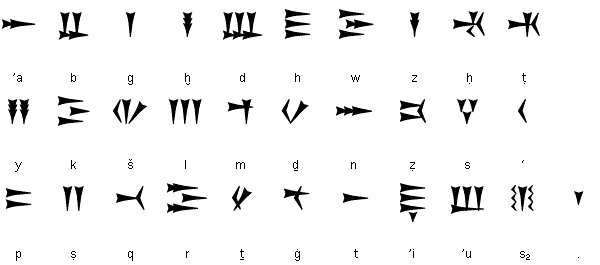
Programmers have used statistical techniques to correlate Ugaritic and Hebrew alphabets as well as forms of words which they assume are somewhat parallel in related languages in order to decipher Ugaritic.
To duplicate the “intuition” that Robinson believed would elude computers, the researchers’ software makes several assumptions. The first is that the language being deciphered is closely related to some other language: In the case of Ugaritic, the researchers chose Hebrew. The next is that there’s a systematic way to map the alphabet of one language on to the alphabet of the other, and that correlated symbols will occur with similar frequencies in the two languages.

The system makes a similar assumption at the level of the word: The languages should have at least some cognates, or words with shared roots, like main and mano in French and Spanish, or homme and hombre. And finally, the system assumes a similar mapping for parts of words. A word like “overloading,” for instance, has both a prefix — “over” — and a suffix — “ing.” The system would anticipate that other words in the language will feature the prefix “over” or the suffix “ing” or both, and that a cognate of “overloading” in another language — say, “surchargeant” in French — would have a similar three-part structure.

The system plays these different levels of correspondence off of each other. It might begin, for instance, with a few competing hypotheses for alphabetical mappings, based entirely on symbol frequency — mapping symbols that occur frequently in one language onto those that occur frequently in the other. Using a type of probabilistic modeling common in artificial-intelligence research, it would then determine which of those mappings seems to have identified a set of consistent suffixes and prefixes. On that basis, it could look for correspondences at the level of the word, and those, in turn, could help it refine its alphabetical mapping. “We iterate through the data hundreds of times, thousands of times,” says Snyder, “and each time, our guesses have higher probability, because we’re actually coming closer to a solution where we get more consistency.” Finally, the system arrives at a point where altering its mappings no longer improves consistency.
Ugaritic was treated as unknown and the resultant translation turned out to be reasonably accurate.

This is beneficial for languages that are related, that is both are derived from a common source. It does not seem to be of use if we discovered a language unrelated to any known ones (unlikely). But it could help with increasing deciphering speed in poorly characterised languages.
“Each language has its own challenges,” Barzilay agrees. “Most likely, a successful decipherment would require one to adjust the method for the peculiarities of a language.” But, she points out, the decipherment of Ugaritic took years and relied on some happy coincidences — such as the discovery of an axe that had the word “axe” written on it in Ugaritic. “The output of our system would have made the process orders of magnitude shorter,” she says.

Indeed, Snyder and Barzilay don’t suppose that a system like the one they designed with Knight would ever replace human decipherers. “But it is a powerful tool that can aid the human decipherment process,” Barzilay says. Moreover, a variation of it could also help expand the versatility of translation software. 

Sunday, 13 September 2009

A definition of information

Message theory has been variously defined in terms of how we recognise design, what information means, and how information can be measured.

German engineer Werner Gitt identifies 5 levels of information.
  1. Statistics
  2. Syntax
  3. Semantics
  4. Pragmatics
  5. Apobetics
I understand the choice of the term "statistics" though I think a preferable term would be something like "storage," or perhaps "transmission quantity" (as storage media may be redundant).

The level of statistics is concerned with the possible options for each symbol and the number of symbols contained in the text block of interest. The number of symbols for binary are 2: 0,1. For English we have 27: letters and word space (punctuation and numbers excluded). For DNA we have 4: A, T, G, C.

Shannon's theory of information does analysis at this level. This level is completely devoid of any meaning, and Shannon may give higher values to messages with zero actual meaning, such as random numbers, than to meaningful statements.

Syntax is the choice of code. A deliberate, though arbitrary, convention of what groups of symbols mean. In English "cat" has meaning, but "ith" does not. And "come" has meaning in English and Italian, but not the same meaning. DNA at the gene level has the convention of codons; groups of 3 nucleotides such as CAC which codes for valine.

Semantics are at the level of communicating ideas. The code itself does not communicate ideas. We need words but we talk in sentences. It is at this level we have meaning. Further, it is at this level meaning is invariant. We could communicate the same idea in a different language which would use a different code (syntax) and result in different storage requirements (statistics).

It is at this level (at least) that information (meaning) needs to be considered when discussing gain and loss of information.

Gitt gives a useful illustration of semantics.
A: The bird singed the song.
B: The green freedom prosecuted the cerebrating house.

Sentence B is perfectly correct syntactically, but is semantically meaningless. In contrast, the semantics of sentence A is acceptable, but its syntax is erroneous.
Pragmatics is about action based on the ideas. And apobetics is about the purpose for the action.

Is important to note that much work has been done at the level of statistics. This is probably largely a result of the computer revolution; though possibly partly because this is the easiest level to define and analyse. But statistics does not discriminate meaning from non-meaning.

Saturday, 16 May 2009

Is all translation interpretation?

In an article about gender issues and the Bible, theologian Vern Poythress makes some important observations.

Poythress is discussing text that has implicit meaning which translators make explicit.
An explicit semantic content in the original has to be inferred in the translation, while what was only inferable from the semantics in the original becomes explicit in the translation. The shift from direct statement to inference is significant. It is a subtle change in meaning. To appreciate this difference fully, biblical scholars have to shift their point of view somewhat. Many biblical scholars spend most of their time thinking and writing about the theological value and interpretive implications of the passages they study. Their goal is to make explicit the many implications of the text. If two wordings leave the theological implications the same, they are equivalent from the scholar's point of view.
Of course we are also removed from the authors and readers of the original text by culture and time, so what may be implicit is still more obvious to them than to us, at least until our way of thinking changes. Though this is not quite what Poythress is getting at; rather the sentence construct: what is said and what is implied but left unsaid.
But literary stylists and linguists studying discourse focus on other aspects of the text. They would note that subtle differences exist between explicit and implicated information, direct and indirect address, active and passive constructions, second person and third person discourse. These produce subtle nuances in the meaning-texture of the total act of communication. Translation into another language never succeeds in conveying absolutely all of such nuances. But the faithful translator endeavors to do so as far as possible.
And this is a significant issue to which not everyone may necessarily subscribe. Do we get the main meaning and ensure that this is fully grasped in the translation, or do we carry across as many meanings as in the original. If the original possibly has a double meaning and we can keep ambiguity, do we? Poythress goes for the latter and I am inclined to agree.
Translators console themselves by saying that "all translation is interpretation." They are right. The most accurate translation can only be accomplished when we thoroughly understand the meaning of the original, including all its nuances in all their dimensions. Only then are we ready to produce a translation that conveys not only the main meaning but all the nuances of the original.

But the motto, "all translation is interpretation," is turned into another meaning if we then use it as a blanket justification for rewriting the text in the way that an interpretive commentary would do. An interpretive commentary expounds the implications of a text, and makes explicit what the text leaves implicit. Such has not generally been the job of mainstream translation. But the American religious public has become lazy about the Bible and busy with other affairs. So a translator may try to include the extra information in the text explicitly, in order to make it easy for them. He paraphrases. He explains metaphors in ordinary prose. He expands tightly packed theological exposition. By doing so, he provides a commentary through which he hopes to help readers to understand the Bible better. But when he labels his commentary "The Bible" and "translation," he has blurred the line between translation and commentary in an unfortunate way.
I tend more and more toward literal translations. Sure, they may not read quite as well as dynamic translations, but to really understand Scripture I think this is what is needed.

Dynamic, easy-reading, and children's Bibles have their place. To pick up the main themes of Scripture it is useful to read an easy-reading, flowing version. Reading a variety of versions allows one to contemplate other possible meanings that may not occur to him when reading his usual translation. But I think it is false when essentially dynamic versions claim to be just as accurate or more accurate than formal versions.

However translation always has limitations. Formal versions need to be aware that some limitations of language cannot easily be bridged. For example the preservation of word order into English is unnecessary and possibly inaccurate. Word order gives meaning more than emphasis in English; best to use normal English word order.

Monday, 19 November 2007

Self opposite

I find it interesting that the same word can have opposite meanings. It just goes to show that it is context that determines meaning. I can think of 2 words in English.

Cleave: join together and separate
Chilli/chilly: hot and cold

Are there others?

Labels

abortion (8) absurdity (1) abuse (1) accountability (2) accusation (1) adultery (1) advice (1) afterlife (6) aid (3) alcohol (1) alphabet (2) analogy (5) analysis (1) anatomy (1) angels (1) animals (10) apologetics (47) apostasy (4) apostles (1) archaeology (23) architecture (1) Ark (1) Assyriology (12) astronomy (5) atheism (14) audio (1) authority (4) authorship (12) aviation (1) Babel (1) baptism (1) beauty (1) behaviour (4) bias (6) Bible (41) biography (4) biology (5) bitterness (1) blasphemy (2) blogging (12) blood (3) books (2) brain (1) browser (1) bureaucracy (3) business (5) calendar (7) cannibalism (2) capitalism (3) carnivory (2) cartography (1) censorship (1) census (2) character (2) charities (1) children (14) Christmas (4) Christology (8) chronology (54) church (4) civility (2) clarity (5) Classics (2) classification (1) climate change (39) coercion (1) community (3) conscience (1) contentment (1) context (2) conversion (3) copyright (5) covenant (1) coveting (1) creation (5) creationism (39) criminals (8) critique (2) crucifixion (14) Crusades (1) culture (4) currency (1) death (5) debate (2) deception (2) definition (16) deluge (9) demons (3) depravity (6) design (9) determinism (27) discernment (4) disciple (1) discipline (2) discrepancies (3) divinity (1) divorce (1) doctrine (4) duty (3) Easter (11) ecology (3) economics (28) education (10) efficiency (2) Egyptology (10) elect (2) emotion (2) enemy (1) energy (6) environment (4) epistles (2) eschatology (6) ethics (36) ethnicity (5) Eucharist (1) eulogy (1) evangelism (2) evil (9) evolution (13) examination (1) exegesis (22) Exodus (1) faith (22) faithfulness (1) fame (1) family (5) fatherhood (2) feminism (1) food (3) foreknowledge (4) forgiveness (4) formatting (2) fraud (1) freewill (29) fruitfulness (1) gematria (4) gender (5) genealogy (11) genetics (6) geography (3) geology (2) globalism (2) glory (6) goodness (3) gospel (4) government (18) grace (9) gratitude (2) Greek (4) happiness (2) healing (1) health (7) heaven (1) Hebrew (4) hell (2) hermeneutics (4) history (24) hoax (5) holiday (5) holiness (5) Holy Spirit (3) honour (1) housing (1) humour (36) hypocrisy (1) ice-age (2) idolatry (4) ignorance (1) image (1) inbox (2) inerrancy (17) infinity (1) information (11) infrastructure (2) insight (2) inspiration (1) integrity (1) intelligence (4) interests (1) internet (3) interpretation (87) interview (1) Islam (4) judgment (20) justice (25) karma (1) kingdom of God (12) kings (1) knowledge (15) language (3) lapsology (7) law (21) leadership (2) libertarianism (12) life (3) linguistics (13) literacy (2) literature (21) logic (33) love (3) lyrics (9) manuscripts (12) marriage (21) martyrdom (2) mathematics (10) matter (4) measurement (1) media (3) medicine (11) memes (1) mercy (4) Messiah (6) miracles (4) mission (1) monotheism (2) moon (1) murder (5) names (1) nativity (7) natural disaster (1) naval (1) numeracy (1) oceanography (1) offence (1) orthodoxy (3) orthopraxy (4) outline (1) paganism (2) palaeontology (4) paleography (1) parable (1) parenting (2) Passover (2) patience (1) peer review (1) peeves (1) perfectionism (2) persecution (2) perseverance (1) pharaohs (5) philanthropy (1) philosophy (34) photography (2) physics (18) physiology (1) plants (3) poetry (2) poison (1) policing (1) politics (31) poverty (9) prayer (2) pride (2) priest (3) priesthood (2) prison (2) privacy (1) productivity (2) progress (1) property (1) prophecy (7) proverb (1) providence (1) quiz (8) quotes (637) rebellion (1) redemption (1) reformation (1) religion (2) repentance (1) requests (1) research (1) resentment (1) resurrection (5) revelation (1) review (4) revival (1) revolution (1) rewards (2) rhetoric (4) sacrifice (4) salt (1) salvation (30) science (44) self-interest (1) selfishness (1) sermon (1) sexuality (20) shame (1) sin (16) sincerity (1) slander (1) slavery (5) socialism (4) sodomy (1) software (4) solar (1) song (2) sovereignty (15) space (1) sport (1) standards (6) statistics (13) stewardship (5) sublime (1) submission (5) subsistence (1) suffering (5) sun (1) survey (1) symbolism (1) tax (3) technology (12) temple (1) testimony (5) theft (2) toledoth (2) trade (3) traffic (1) tragedy (1) translation (19) transport (1) Trinity (2) truth (27) typing (1) typography (1) vegetarianism (2) vice (2) video (10) virtue (1) warfare (7) water (2) wealth (9) weird (6) willpower (4) wisdom (4) witness (1) work (10) worldview (4)